NEWS & INFO
Women In Trades Wednesday- Chantelle Galvin
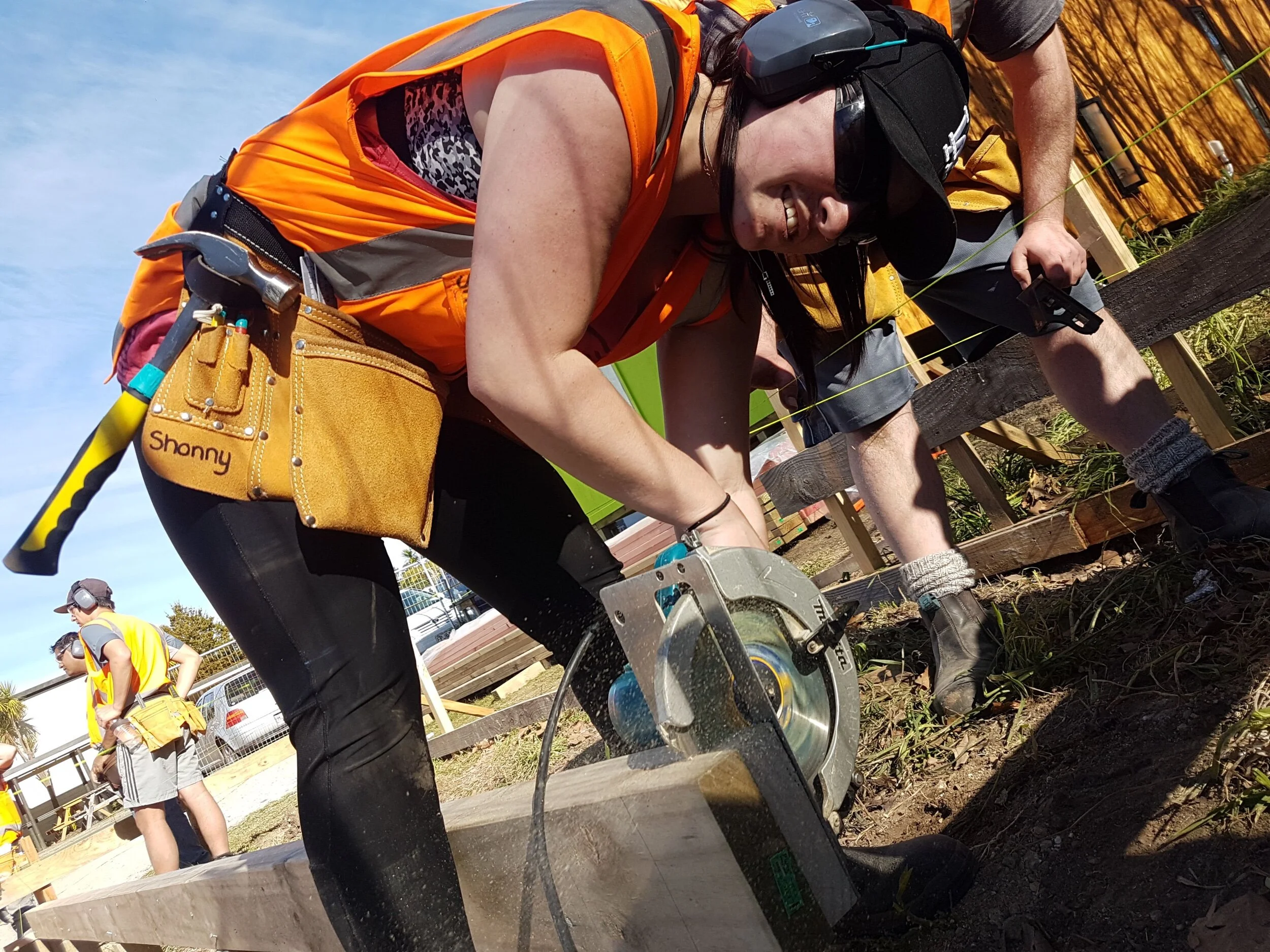
Chantelle Osborne-Galvin is a second-year carpentry apprentice based in Rotorua. She is currently completing her apprenticeship through Toi-Ohomai ITABS.
On how she got into her carpentry career, Chantelle explains that it wasn’t easy to find a job in her local and surrounding area- “I actually struggled to find a job in the industry. I looked as far as Taupo and Tauranga (I live in Rotorua) but still struggled, so I had to find a job in another industry while looking for the work I wanted. I was on the unemployment benefit through Work and Income when they found me a job in an administration role. I took this job and continued to look for building jobs. Over one year later, Work and Income contacted me again saying a business in Rotorua was looking for a labourer/apprentice. I met up with my now boss and had a meeting/relaxed interview and I got the job on the condition that I could start my apprenticeship after my 3-month trial.”
Not many of Chantelle’s work days look the same- “One day I’ll be digging holes for piles and the next day I might be putting in wall insulation or cladding a house. The variation is incredible. But being the newest apprentice in our team, I’m usually always doing the dirtier and/or harder jobs like digging holes, doing hardware etc.”
On what got her into her building career, a feeling that things needed to change was a motivating factor; “My specialty before carpentry was in tourism and hospitality. I dropped out of high school to complete a Diploma in Tourism Management. But it wasn't what I wanted to do. I googled job ideas and building popped up. I’d be lying if I said I didn't look up how much they earn- I got a bit more encouraged by that! Because I had absolutely no background in building and hadn't grown up around a Dad, Granddad or Uncle in the trades, I had no idea what I was doing- so I did the pre-trade course at Toi-Ohomai Rotorua. I took a spontaneous chance at trying something different and it worked out way better than I could have even imagined.”
Chantelle tells us about some challenges she’s had to overcome to get to her current point: “I’m a massive control freak, but being an apprentice means I’m at the bottom of the food chain. I have no control, and I’ve had to accept that- in the hope that one day I’ll get the control back in the form of being a site foreman and/or owning my own construction company. Also, being discriminated against- Not always said out loud by others, but in their actions. I have been to a job interview where the boss questioned my ability to do certain tasks such as 'heavy lifting' because I'm "a female and my strength may not be that of a male". I’ve had to change the way I portray myself on site so that the boys see me as equal and not above or below them. I don’t like getting special treatment for being a female, and I don’t mind struggling and asking for help if I’m given the opportunity like my workmates.”
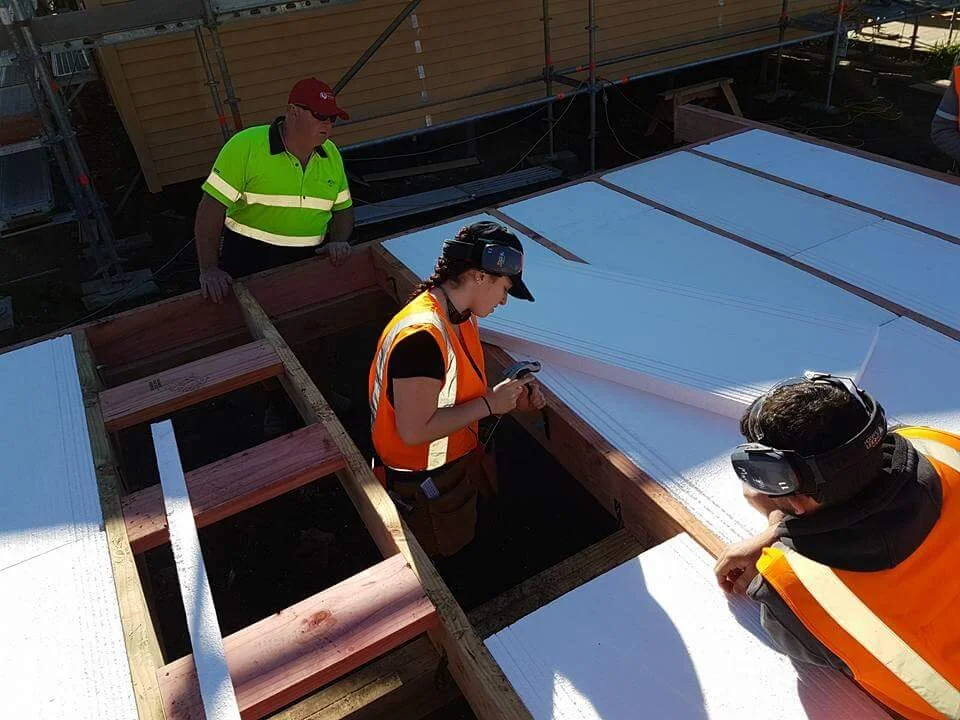
Aside from the challenges a building trade can bring, Chantelle still has many parts of her work that she enjoys- “I love the variety of work first and foremost. I love completing different tasks everyday. I think my favourite part of my job is seeing the progression, both of myself and how far I’ve come, and also the projects we work on- starting from scratch with a slab of dirt, and making it into potentially the biggest asset/investment of someone’s life.”
Most proud career achievements to date? Chantelle fills us in: “Just being a female and making it in this industry! I know many males who couldn’t do it, both physically and mentally/intellectually. Making a massive, scary career move like I did from tourism/hospitality to building and just loving it and loving my decision. Also, every day for me is a proud moment- every day I learn something new about myself and what i’m capable of. E.g. upgrading from being told what to do all the time, to being told to go read the plans, and be able to do that and understand what I’m doing and why I’m doing it.”
Chantelle has many aspirations for the future- “I use the term “goals” loosely as I’m only now beginning to make moves and haven't physically written them down and planned for them- YET. I really want to be more involved in the women in trades community. Communicating with other women in different trades from all over the country and if the opportunity was to arise, overseas. I want to be able to speak to women who may be considering a job in the trades and encourage them, giving them a support network, making it easier for them than it was for myself and many other women. I want to be a qualified LBP (licenced building practitioner) with aspirations to someday own my own business - probably with many years of experience under my belt. I would absolutely LOVE the opportunity to build in other countries and see how things are done, broaden my knowledge and skills.”
On how her career choice has impacted her life outside work, your life outside work, Chantelle explains that both her social life and self-confidence have been affected in different ways, she explains: “I’ve really struggled with making new female friends. Because I’m the only female in the company, the relationships with the guys are different than what they would be with females. I believe it can be quite a lonely trade if you’re not super outgoing or a social butterfly. Outside of work, I don’t socialise a lot so therefore find it really hard to make friends that aren’t work mates. Over the years, I’ve become more confident in myself and my abilities. I see it as "I can do a job that is male dominated. If I can do that I can do *this*". Because building is a very physical job, I think it has had a negative impact on my home/social life- after a long day at work I just want to come home, relax and sleep instead of going out to socialise like other 'normal’ 22-year-olds. Apart from weekends, I don’t have much energy for "me" time.”
Advice Chantelle would you give someone looking to get into carpentry is: “Just go for it! Don't take things too seriously and just enjoy the process. You’ll see yourself transform into such a strong, independent woman. It is hard at the start- I’m not going to lie. But everything that’s worth it is not going to be easy. You will more than likely struggle with people underestimating you and questioning your abilities, but stay strong in your values and beliefs and don’t let anyone change you! I think if you’ve made the decision to get into any trade, you have the ability to make it! Trades intimidate many women, and they think they can’t do it. Just make the move and be yourself, you won’t regret it! It’s such a rewarding career mentally, physically, emotionally- everything!”

Women In Trades Wednesday- Leah Herlihy

Leah Herlihy is a Quarry Dump Truck and Machinery Operator at Bellingham Quarries Ltd, who has been working in the industry for about 2.5 years. Previous to this, Leah worked as a Site Traffic Management Supervisor.
Family ties to the quarry at the time ended up being Leah’s foot in the door to the quarrying industry, she explains: “I got My job through my step dad who used to work here part time. Management asked him if he knew anyone who wanted a part time job over the stripping season (removal of dirt or clay sitting on top of the rock to be processed). He said I would be interested in having a go, they said yes- if he trained me up, which he did over a couple of hours one Sunday afternoon. I was offered a full- time contract on the Monday, and started work at the quarry two weeks later, after I had worked out my notice at AWF where I was an STMS.”
Holding her wheels, tracks and rollers licence endorsements, Leah’s days see her busy with a variety of work that involves operating many of the machines in the quarry. “I like the fact that there are never two days the same. Some days I could be in the loader, loading trucks up with metal, other days I could be pushing dirt with the bulldozer, or I could be in the Volvo A30F dump truck moving various materials.”
While working in a traditionally masculine field can have its challenges- Leah notes that it took a while for her to be treated equally, her motivation is clear- “I just really wanted to prove that a girl could actually do it!” She also mentions the pay as being one of the things she enjoys most about the work she does.

Leah counts getting to train new crew members as some of her most proud moments- “It’s knowing that the bosses trust me and my decisions”. She also has some pretty cool goals for the future: “To get my road truck and trailer licence, and maybe try out working in an Aussie mine!”
Despite the enjoyment Leah gets from her career, there have been some adjustments to her personal life that she’s had to navigate since taking on a career in a quarry- “I have less time for social activity when working long hours, and 6 days a week in peak season. There’s less time to get to the gym- which is a new hobby, and less time to spend with family at gatherings.”
Included in Leah’s proudest moments is that “I am the first and only female working at the quarry in its 80-year history! I also still hold the NZ Junior record for a fish I caught years ago.” She is also a bit of a car lover- “My parents have always had classics and hot-rods and I definitely have caught their car bug!”
Advice Leah would give to someone looking to get into her line of work is: “You must have a bit of a thick skin to work in an all- male environment, but if you truly have the passion then just go for it! If you go into this industry, you will definitely have a laugh. To be honest, at times you will probably have a cry too. I find training the new or temporary guys a laugh - sometimes it’s a ‘fear for my life’ feeling, or a pee my pants laughing situation!”
“Below is a team photo from an award we won. Thanks to Bellingham’s Quarries for giving me a chance- that’s all girls need is for someone like them to give you a try. If you’re really wanting to get into this industry, go and ask if you can do a free day’s work and see what happens- you never know, you might end up with a job!”

Women In Trades Wednesday- Olivia Broadhurst
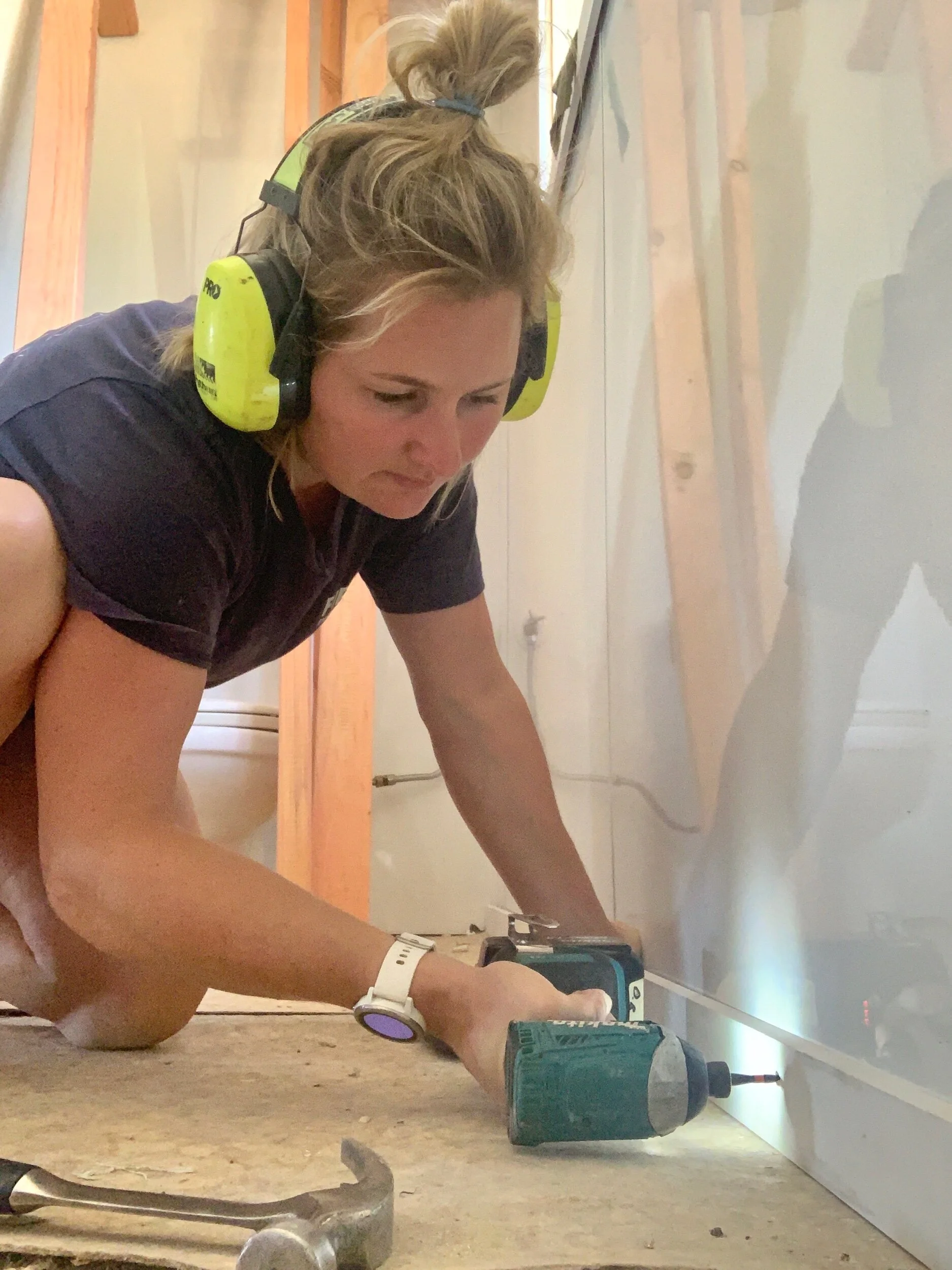
Olivia Broadhurst has been working in the building industry for over 6 years. She completed her qualification through BCITO in 2017 and is now a qualified carpenter and registered LBP (Licensed Building Practitioner).
On how she got into a career in trades, Olivia says: “It was not a decision I’d ever thought about. The opportunity arose to do some labouring when I was just out of school and desperate for a job. That’s where I discovered my passion for building, I’m very fortunate to have been given that opportunity.”
Working for herself, Olivia’s days are a real mix of both on the tools and behind the scenes work- “My usual day is 7am -4:30pm, I generally plan my weeks in advance as to what site I will be on. I project manage all my jobs, and do the quotes and estimate, everything that goes with running my own business- I spend one afternoon a week doing book work and generally 5-6 days on the tools. I specialise in full house renovations and small jobs like decks and bathroom renovations, but I am taking on a new build at the end of this year. My weeks are jam-packed and busy, but I love the challenge of renovations and turning old into new.”
There have been a few challenges along the way, but Olivia cites support from groups like the Tradie Lady Club as being inspiration for her to keep going. “Being in a male dominated industry always has its moments, mentally and emotionally. Getting through my apprenticeship had its moments and many times i wanted to quit but I got through and am happy with where I am now.”
On what she loves about her trade, she explains: “Everything! I love project management, I love being outside, I love learning, I love creating things with my hands. How could you not love building? It’s just such a satisfying job in every aspect!”
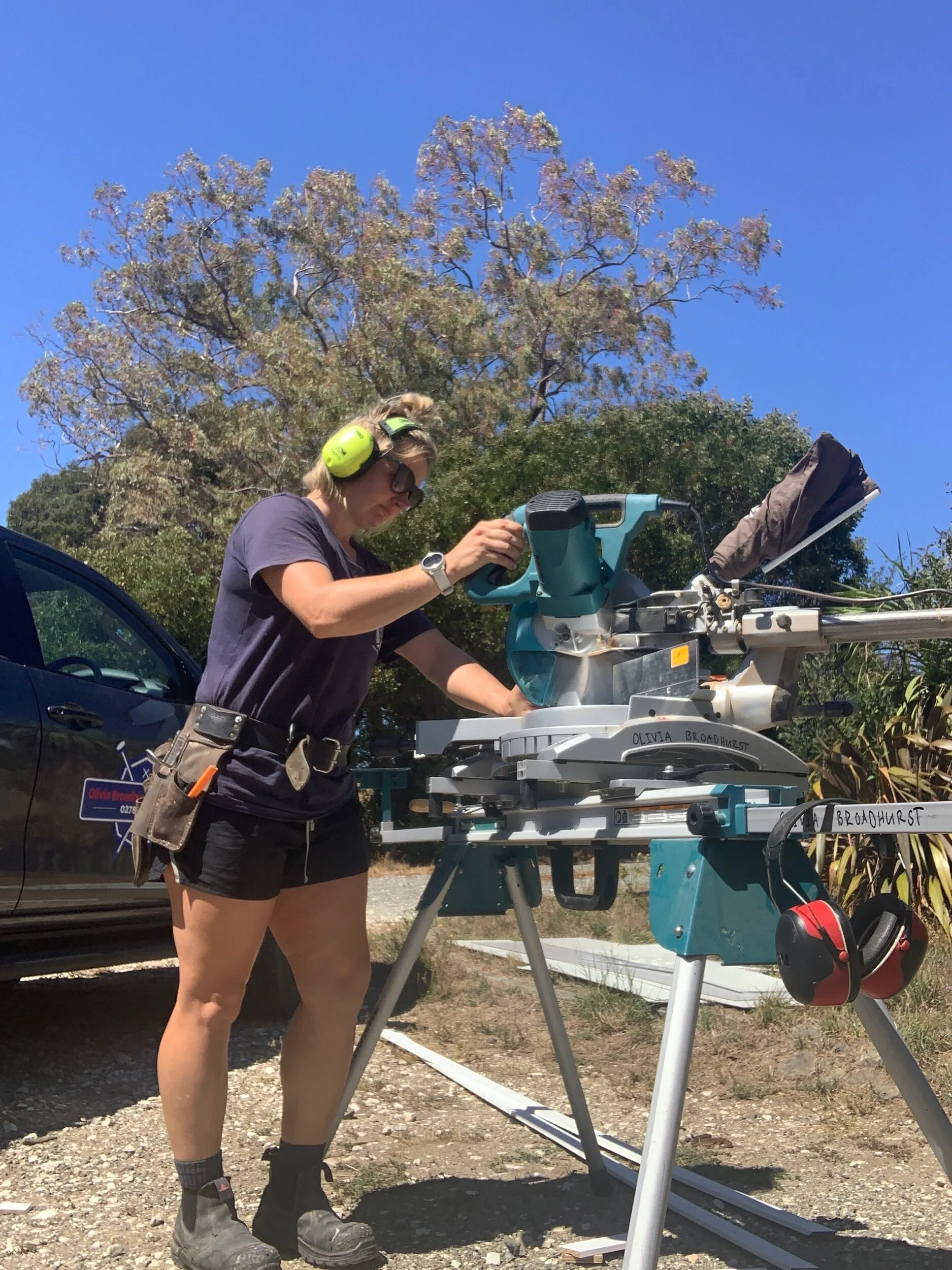
Olivia isn’t short on career achievements to be proud of: “I have been lucky enough to win the Top of the South Apprentice of the Year 2017, 2nd place Women in Construction Achievement award 2018, Licensed builder practitioner 2018, and just getting to where I am in my career is an achievement in my eyes.”
Outside of work, Olivia spends a lot of time each year hunting all over the South Island- “It’s a hobby my husband and I share and have great passion for. I was brought up by a single mum- the opportunity for me to hunt and provide free range meat for my family was what started it. I was also lucky enough to marry the love of my life December last year, and no he is not a builder!”
As for the future, she has some pretty cool goals in place- “I want to try to build up my company and expand to a small team of hopefully girls and guys, possibly do a wee Aussie stint before I grow my business. My main goal this year is to encourage and support young women and share my story of how I got here via Instagram” (Olivia’s page can be found by searching @oliviabroadhurstbuilding_ on Instagram).
On how her choice of career has impacted her life outside of work, Olivia explains there’s been a few positive effects- “When I started building, I was a shy insecure young lady who had absolutely no opinion about anything, took everything to heart and was easily offended. Now I am confident with all my work, I am tough mentally and physically it takes a lot for someone to upset me. I’m strong, fit, healthy, more energetic and enthusiastic about everything I do at home and work.”
Some advice Olivia would give someone looking to get into building? “Try to get some work experience and give it your best shot. Show enthusiasm, ask questions and don’t be put off by what anyone says. Your career is your choice.”
Women In Trades Wednesday- Ginevra Wohlstadt

31 year-old Ginevra Wohlstadt is a co-owner and machine operator at Atlas Earthworks, based in Tauranga, Bay of Plenty but she is originally from Adelaide, South Australia. “I have been in the New Zealand landscaping and construction industry since I moved here 5 years ago. I previously spent 10 years in the Australian Mining industry as a Blast Hole Driller and other Geotech roles.”
What exactly does her current job entail? Ginevra explains: “We do landscaping and concrete prep and we have been up and running in Tauranga for almost 3 years. We run a T590 Bobcat Skid-steer and two trucks (6-wheeler & 4-wheeler) and hire various sized diggers (1.7t to 30 tonne) depending on what the job calls for.”
On how she first got into the mining and drilling side of things, the thought of large student debt and low job prospects upon graduation in her preferred areas of agriculture and natural resource management, due to a long period of drought “seemed ridiculous, and also a bit boring!”
Ginevra ended up choosing something a little different from her original preference- “A 6-month Geoscience course at TAFE (Polytech) which only cost around $1500 and had all the fun stuff - geology, mapping, mineralogy, 4 Wheel driving courses, basic motor mechanics just to name a few things.” The day after her course ended, Ginevra started a new job as a geologist assistant for a fledging uranium exploration company in South Australia- “I spent the next few years travelling around drilling sites in SA, NT & WA working as a Fly In-Fly Out Geologist's assistant.
I then moved more into the operating side of the drilling industry, starting on my first drilling rig, an Atlas Copco L7 at the age of 19. All of my drilling training was done on site from two of my mentors (Doug and Les) and I also had to keep doing my daily job as a Pit Technician, so training was a slow process until a job position opened up on their roster. From then on, I worked as a production driller for a family owned drilling sub-contractor and then an earthmoving company in many different mines; nickel, manganese, gold and iron ore. I finished the last few years of my drilling career as a driller and a trainer for these companies, teaching new drillers the ropes, developing their skills and drilling styles.”
Since moving to NZ 5 years ago, Ginevra’s career demands have changed pace somewhat- “These days, my daily routine is a lot less hectic and less demanding- I don’t have to catch a plane to site for two weeks on an isolated mine site (one week of those being night shift) No 4.30am starts or pushing casing pipe knee deep in muddy water in 45 degree heat, day in and day out. Don’t get me wrong- I loved this work and it gave me most of the knowledge and experience I have now, but I did put my young body through a lot of hard work- for 10 years straight. Nowadays, we get to organise our work week to suit our lifestyle and days off, we can be working only half an hour from home and we have greater day to day satisfaction operating our own machines.”

So, what does an earthworks company like Atlas Earthworks do, and how is she involved in the operations? Ginevra explains: “We will have a mix of jobs lined up for the week, usually 3-5 house sites- depending on the size, mostly new builds that are nearly complete and are needing a big clean up and cut out for their landscape and concrete design.
Horton (co-owner and operator) and I swap out most days between the machine and trucks; we have similar operating experience so it makes it easy to tap out and have a break so not one person is loaded with a task only they can do. Mostly it’ll be clearing cleanfill and building site rubbish, digging garden beds, flattening areas for lawn and installing topsoil, laying base course for patios and driveway concrete, all whilst following the set plan and budget. This involves a mix of bobcat work, shovelling and raking by hand, and carting materials in and out with our trucks.
After we’ve been through the building site, it starts to look more like a home, so our before and after photos look awesome! Other private jobs we will have quoted a few weeks prior and usually get out of town into more rural areas and stretch our legs a bit with large scale garden and lawn redevelopment; installing rock walls, dig outs for pools, replacing old driveways ready for new concrete and removing large overgrown vegetation. This type of work is the most satisfying as we get to travel around a bit more to beautiful settings in the Bay of Plenty and have more face time with our clients.”
On what inspired Ginevra to pursue her lines of work, she notes that coming from a farming background in regional South Australia, working outdoors has always been a part of her life- it was a natural choice for her to be sculpting earth and mucking around on machinery. It also didn’t matter to her about getting muddy, dirty or greasy!
“When I started in 2006, the drilling industry was only around 4% female, so it made me more motivated to be successful in my role. Also around this time, mining companies and supervisors were just beginning to realise that female operators were more attentive to their machines, took less risks and reported hazards more frequently than their male counterparts; so then the cogs started to turn on the disparity between gender and job opportunities- the light was starting to shine through the cracks in my chosen pathway. I knew that this was a career I wanted to be a part of for the long term and I saw it as every hurdle that I had to tackle would be one less for the female following in my footsteps.”
One of the biggest challenges Ginevra has faced was transitioning from a very well-established mining career to starting from scratch in a new pathway here in NZ. “Many FIFO workers and especially their families will know first hand the impact of working fly in-fly out can have, so whilst I knew I had made the right decision about my future, it was hard not feeling guilty about putting aside a very-well paying and solid career for a healthier and simpler lifestyle. I know it was certainly the right decision for me mentally and physically; even though there are more overhead things to worry about, (taxes, bills, invoicing etc.) my day to day mental health is a lot better being free from the constraints that mining and especially FIFO had on my daily life. Not to mention the incredible landscapes, scenery and activities NZ has to offer!”

On what she loves the most in her current role, Ginevra explains: “For me personally, I need to see the actual work I have done for the day, as opposed to writing reports or having long meetings discussing work, so with the type of work we do I can see results within a few hours which is very satisfying for me on a daily basis. That also translates to our clients, who may not be able to imagine or picture the “3D” finished product, so when we have completed a job, the look of joy on a client's face to see their plans finally mapped out or their ideas turn into reality is really pleasing for me. Also, it's a lot more creative than most people think, so as a creative type it's a great way to keep that side of my brain active!”
Ginevra counts purchasing their first truck and Bobcat as a massive career highlight- “It has been a dream of mine since I was about 20, because I knew that owning the actual machinery was the best way to get ahead and become a business owner. I am also lucky enough that my partner Horton shared the same dream and had a similar skill set so we were able to work out how to do it together.”
Where would Ginevra like to see her future take her? She would love to be able to give young students, especially females, the opportunity to jump on a machine and give it a go! “Machine operating has a bit of a knack to it and some people are naturally gifted, but if you don’t have the chance to try you may never find out that operating is for you. So being able to run hands-on training days with students would be something I would love to invest in and give back to my industry.”
On how her career choices have impacted her life, Ginevra believes that building relationships with those you work with and for has been a positive point- “The mining industry portion of my life was awesome as it helped finance my love of travel but more importantly helped me create a global network of friends and industry affiliates that I still have to this day. The network of people in your life is your strongest asset and the more you invest in those people and relationships, the more successful the other aspects of your life will be whether it’s achieving personal goals or launching a business.”
Ginevra’s skills learned through both her careers have also been transferable to one of her other passions- “I volunteer at Tauranga Musical Theatre, and also perform or direct shows from time to time, so I am able to bring my particular skill set to our non-for-profit society. Whether it’s set building with my bag of tools or bringing the truck around for a working bee, you never know how your set of skills can be appreciated by others. I always encourage people to volunteer in something that is also their hobby or passion because non-for-profit organisations thrive off a variety of talented people - especially tradies!”
Advice she would give someone looking to get into her line of work is: “Always be willing to work your way up- you will gain more experience and knowledge by doing all tasks, not just the things you fancy. No one just applies to be a baker or a chef, you have to try and learn as many ingredients and recipes as you can first!”
Women In Trades Wednesday- Jen McLean

Jen McLean is an Electrical Fitter who has been working in the industry 18 years. She began her apprenticeship at age 17, and she’s now 35.
“My 2 boys are super proud when mum comes to their school or kindy to help out with my tools! That’s a good feeling!”
Jen is from a mining town in Canada, where she says opportunity in trades was aplenty. As a teenager, she wanted to be a writer, (she wanted to write text books!) - but didnt want to get a student loan to go to university. “I figured if I got a trade and got a job at the mine, it would help me be a more well-rounded person, as the hands-on experience, the focus on technical skills, and the need for competency in maths and sciences would make me push out and develop aspects of my brain/self that weren't necessarily my "core strengths". And then, once I had a career, I could support myself through uni if I still wanted to go.”
Why electrical? Jen explains: “I picked electrical because - well - it was as good a trade as any, at the time. I thought it would be great to learn how to read drawings, I think that’s why I chose it, to start out with. But once I got my job and got stuck in, I realised it was the taking stuff apart and putting it back together that I enjoyed. The journey I have been on has been, as a result, quite hands-on, mostly with big stuff - work in substations and switchyards, power stations, etc.”
Trade school was challenging for Jen as math wasn't her strong suit- “It just meant I had to work harder. It was rewarding to nail stuff that was actually really "hard" for me; but there are plenty of people who helped me along the way. I ended up doing really well on all my exams, and I got ESITO Apprentice of the Year in the final year of my apprenticeship (ESITO was the training organisation that has been replaced by Connexis).”
Jen’s favourite part of her work is when she works on HV transformers, circuit breakers, generators, and the likes. “I have developed a huge passion for asset health, and learning what the plant needs in order to live its best life, and then doing my best to help achieve that. My love of technical writing has made me a unique tradie, and I have loved the part of my job where we are constantly making things better for the future. Creating procedures when they don't exist; researching plant history, developing strategies to maintain plant for the long run. I've been a bit different from those around me in that regard, and it has paid off for my company (I think they call that diversity!)”
A typical day at work for Jen includes things like maintenance, operating (HV), permitting, inspecting, fault finding, meetings, developing maintenance plans, planning jobs, upskilling, training, research, pricing... “It could be any combination of these things! No two days are the same.”
Jen points out that there is a unique set of challenges for women working in the masculine industries- “Everyone has their own journey and experience. The important thing is to find mentorship when you need it, reach out to others who you can identify with, and do what you do because you love it. The challenges I face are my chosen set of challenges, and there is reward in overcoming those. I don't get it right every time, but I am constantly learning about myself, about others, and about how to get the most out of the relationships with those around me. that journey never really ends.”
On what she loves most about her trade, Jen explains: “The ability to use my skillset to give back to my community in a super useful way. Also, the fact that I will NEVER be without work (unless it’s by choice). I have recently resigned from my "dream job" -and am super stoked about how exciting it is to be going out and finding new challenges and opportunities. A dream job doesn't always mean a forever job.... sometimes you gotta slay it and move on - and don't look back!
Jen lists her most proud career achievement as “snagging my dream job as a generation technician, something that I've wanted to do since I first moved to NZ at the age of 20!” and includes continuing to grow her core skills, and to keep learning how to be a good leader-not by title but by action, as some things she plans to continue working on in the future.
Advice she would give someone looking to get into her trade? “Just give it a crack, I guess. Back yourself. Don't let people's perception of you dictate the choices that you're going to make.”
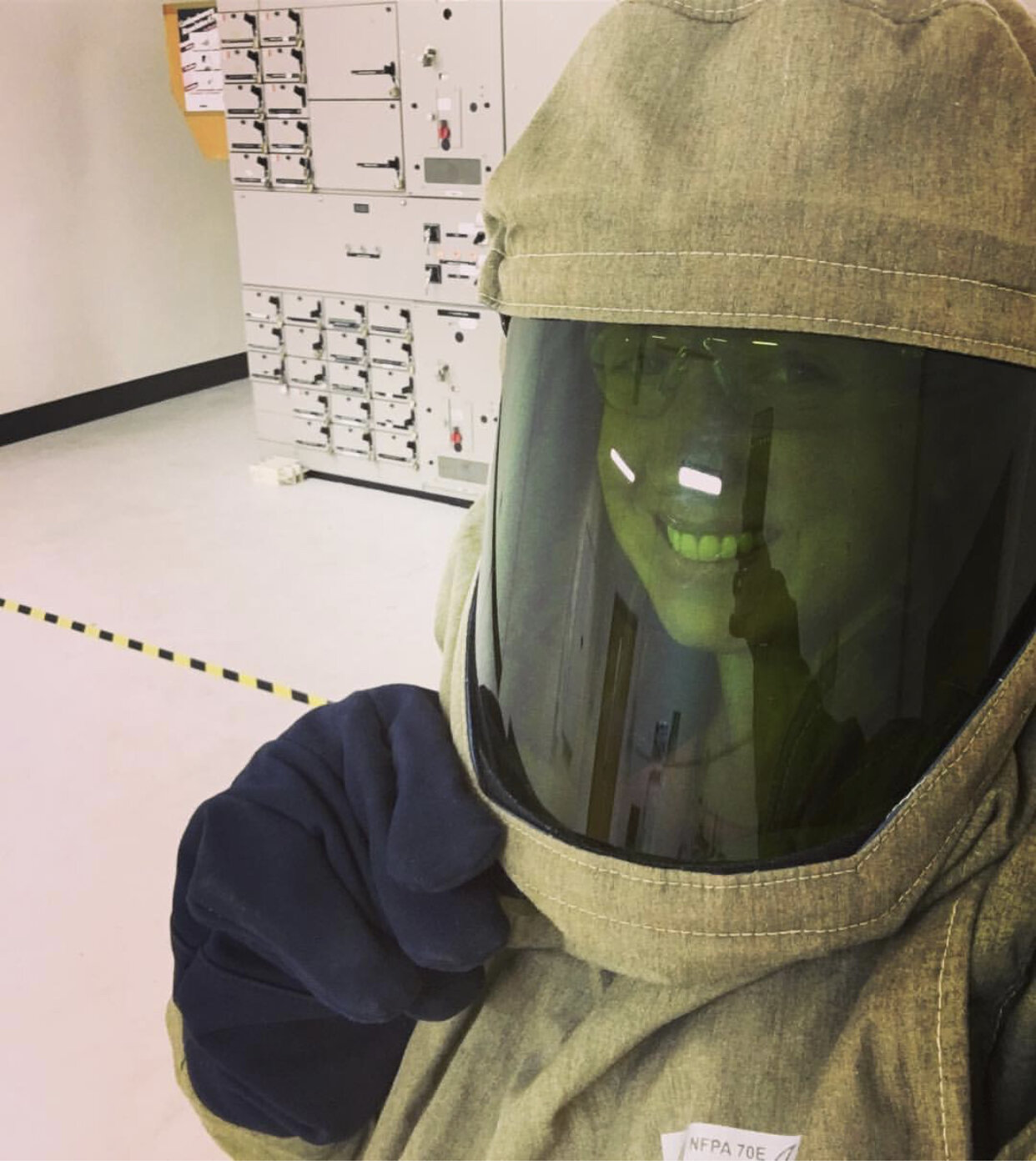


Women In Trades Wednesday- Heather

Heather is a carpenter, currently completing the final months of her apprenticeship. A typical work day doesn’t really exist for Heather- “In building, each day changes with the build process, im involved with the slab, frames, roofing, cladding, internal lining, cabinets, decks ... The list goes on.”
On what got her into her trade career, she notes the Christchurch rebuild is where it all started- “The 2010 Christchurch earthquake got me into laboring for building companies. It took me 5-6 years of trying, to find a company that accepted me.”
Now, Heather counts all the dogs she gets to pat (can we pick this as a career just based on this?!) amongst the thing she loves about her trade. “The other best part is seeing property owners enjoying what we have built for them.”
Heather’s most proud career achievement “was when one of my bosses refused to do some certain finishing work because he feared that I would tell him off for not getting it to my high standard!”
Future career goals for Heather include getting involved with bringing more people into the trades. Advice she would give others considering a trade career is: “I would want others looking at getting into a trade to not be shy, its 2020, anything is possible nowadays!!There's so many trades and subtrades so you’ll find the one for you!”


Women In Trades Wednesday- Martina Perez

Martina Perez is a hydro operator who has been working in the industry for 5 years.
After finishing her degree and moving to New Zealand, Martina started looking for opportunities in the power generation/electricity industry- “I applied for the job and got it!”
What is a Hydro operator, you might be thinking? “A hydro operator is the person responsible to ensure the safety of the activities around the plant. In order to do so, we have to isolate the hydro generators, dams, local services or our own power lines from any source of energy such as water, oil, electricity, etc.” Martina explains.
How does someone train to become a hydro operator? Martina describes her journey- “You are normally trained by your employer. On top of that, some companies also give you the opportunity to obtain L4 Operator/Maintainer Competency, which is managed with Connexis.
I studied marine engineering, which is what leads you to be a chief engineer on a merchant ship. I always describe a ship like a mini city that can produce everything you need- from fresh water, to steam to electricity. I was amazed by how much you can actually create from very little when there are systems in place! I didn’t fully enjoy being at sea all the time, so I chose a similar industry on land. Power generation seemed to fit perfectly.”
Aside from the day to day challenges of the job itself, there are times Martina has been faced with others from time to time, such as- “Lack of trust from others, not believing I could do it, lack of women’s PPE, not being acknowledged, lack of opportunities, being treated like a princess, and the list goes on… Some challenges come from society and you can do very little about them as your circle of influence is limited (at least at the start of your career), but some others come from oneself. These are the ones you can actually manage and overcome, and when you do you feel rewarded the most, but most importantly it is then when you start also changing society.”
On what she loves about her job, Martina says- “The challenging moments that make you think outside the box, depending on the situation you are in. The feeling of powering a country is quite likeable too!”
Martina notes several standout proud moments so far in her career, including- “Achieving something I didn’t think I was ready to achieve on my own. I put my hand up to manage and be the lead operator for a whole unit outage just 2 years after starting my career. It was a complete success and although there were people backing me up, I was alone all the way and that made me have a sense of achievement I had never felt before.”
As for Martina’s future career goals- “To get into Project Management within the electricity industry. Throughout my career I have experienced the struggles and the pressure people on the ground feel when project management is not good enough, this and the fact that I love planning make me think that this should be my next step!”
On how her choice of career has impacted her life outside of work, Martina notes- “I am a bit of a clown outside work and people normally don’t take me seriously or think I’m silly. Until they ask me what I do for living, then the look changes and that makes me feel powerful and hence more confident!”
Advice Martina would you give someone looking to get into her line of work is- “Don’t even think about it more than twice, go for it! If you like being challenged by situations and people, problem solving, looking cool in your PPE, the feeling of creating, maintaining or operating the infrastructure of a country, THIS IS YOUR PLACE!!”


Women In Trades Wednesday- Holly Haddock

Holly Haddock works in the concrete and construction industry, for Higgins Concrete in Nelson- they supply the concrete! She is currently working on her National Certificate in Concrete Production with BCITO.
Holly has been in the industry for just over 5 years now and says of her experience so far: “It’s been amazing! I worked a year and a half for a placing company doing acid washing, exposing and sealing of concrete, I then went to another concrete plant down in Christchurch where I was living at the time and did 3 years of training down there. Now I am back at home in sunny Nelson with Higgins Concrete and I've almost been here a year. I've never been so happy within a job EVER! and that's saying something!”
A simple google search started Holly in the direction of her current job- “When I finished up with the placing company, I just googled "concrete companies Christchurch" and I sent my CV around to probably 10 places. A company got back to me asking if I would be keen to do some training with them- I took the leap!”
A day at work for Holly is never the same as the last- “One day could be spent it in the yard driving the loader, the next I could be out all day doing on-site testing, which is good for me because it lets me engage in person with the customers I speak to on the phone. Putting a face to a name is always really nice.”
On what inspired her to choose a career in concrete production, Holly says- “Once I got a taste of concrete (not literally) I just absolutely fell in love! There's so much behind it. To learn about it from basically the ground up- fundamentals, how it all works, and the knowledge behind it really sparks me up and gets me going!”
While she loves her job, there is a bit of a challenge Holly has had to overcome- “The biggest challenge I feel I’ve overcome to get to where I am today, would be gaining respect from customers. A lot of the time answering the phone, especially in a construction trade, males want to talk to males because hearing a females’ voice makes them assume that I'm not sure what I'm talking about. Overcoming that and building a rapport with our customers has been so important to me! Working for a family owned company that also respects that has been a huge advantage for me too.”
On what she loves most about her job, Holly has a hard time narrowing -down her options- “I love everything about my job! Even if I feel like it’s getting a bit repetitive, I'll switch up the way I would usually do things on the day and just have fun with it! I'm constantly learning new things every day about my industry and I'm never afraid to ask any questions.”
Holly’s most proud career achievements are also hard to pick from—“For sure completing all the training I have done so far. I also feel like I can't pin point it. I'm proud of myself for doing what I love every day, and being part of a movement that is changing so trades aren't always going to be a "male dominant industry" forever.”
Where does Holly see the future taking her? “Definitely just to see how far my trade can take me! The sky is the limit for me, and fortunately I work with such a great team so we are always encouraging each other to reach our goals.”
Holly feels the only lifestyle change she has had to make for her industry is to get used to starting work very early- “My body clock will wake me up at around 3am most days, but it gets me up and productive on the weekends!”
Advice Holly would give someone looking to get into concrete production is- “Just go for it! Get stuck in and you will surprise yourself with what you can achieve. Proving people wrong that think you can't do things is the best feeling! The industry is getting better but finding an employer that wants you to succeed as much as you do is also very important.”

Women In Trades Wednesday- Rachelle Dunn

Rachelle Dunn, wife to Rob and mum of two adult girls I am currently employed by a logging contractor to process logs- ie cut log stems to length on a skid site in the bush. I operate his Sumitomo 370 machine which weighs nearly 40 tonnes, with a Southstar processing head that weighs around 4 tonne. In the last 6 months, my role has changed a bit. I’m helping out in his office/admin work half of my day, then heading out to the bush crews for the other half of the day to help with quality control or to process logs.
I started working in the bush in 2014 at the age of 41, after 20ish years working in corporate offices. I had always wanted to be in an outside job and loved the openness and isolation of the bush. I was also really interested in big machinery, not worried about getting dirty, and wanted to be part of an operational team. While working in an office for a corporate forestry company, I approached a logging contractor and asked them about how I could get into the industry. He told me they would take me on if I was keen to learn and showed enthusiasm.
I started on the skids, marking and checking quality of the logs, and hopped onto the processing machine every smoko while the regular operator was having a break. My time in the seat got more often where I could fill for people. After 2 years, the regular operator moved onto another crew and I got his seat full time. I’ve been processing on a machine full time for 4 years.
My day starts at 5.30am, driving to the bush site that we are working in. We have a crew toolbox meeting and start work at 7.00am in the machines. We work through until 3.30 then head home. We can be up to an hours’ drive away from home, so it makes for a long day. If it’s a good day and the machine is running well, I could cut up to 600 tonnes of logs. But sometimes a hose on the machine could blow and I’d have to replace it, or something could break on the machine which would need repairing. Being a team, the others would always help out to get the machine back up and running as quick as possible. At the end of the day I’m required to do general maintenance on the machine which includes greasing and filling with fuel and oils. This is the most challenging part of my job, as the physical part of lifting and moving containers of oils around on unstable ground is harder for me. Also, I’m not very mechanical minded. But as a mentioned before, there’s always someone to help out, and its really enjoyable learning that side of the job and being able to do it myself.
I love being in a big machine, I enjoy feeling the power and strength of them and how easy they can lift and move up to 3 tonne logs. I enjoy being outdoors, away from all the busy town people, just being with my crew who we get to know pretty well and have a lot of banter and laughter. I like the rewarding feeling at the end of the day seeing what we’ve produced as a team. And its so cool seeing the logs I’ve cut on a back of a truck heading to a port or mill. Being in the bush or on a machine is not a job just for guys. If you are willing to work hard, get dirty, can give banter and take it, it’s a great fun career choice.


Women In Trades Wednesday- Lydia Hill

Lydia Hill is a Machine Operator who has been working in the industry for 10 years. Holding her truck licences class 2 and 4L, Lydia also holds her wheels, tracks and rollers endorsements, tickets she gained through North Tec Whanagrei.
Day to day tasks are constantly changing for Lydia- “It changes every day to every week. Some days I can be stripping top soil and cutting out house pads which I am still learning about, or I could be building bunds, cutting drains, stripping roads…there is just so much that goes on in any given day in earthworks- it's never dull!”
Early on, Lydia wanted to be an air hostess, but her grandfather who owned an agricultural contracting business needed someone to work, and due to there being no males available to take it on, she was it! “I didn’t see myself doing this for a life career, but ending up enjoying it when i ventured out on my own. After 4-5 years of working for my grandfather, I moved to Auckland and started a life for myself continuing what I knew best (earthworks).”
Working in construction hasn’t been without challenges to face to get Lydia where she is now- “Being female in this trade is hard! I've worked in a few different types of earthworks and always come across some males that are against women in this trade and think they belong in the kitchen. I’ve even had men try to get me fired. I found my biggest challenge was to build my skin thicker and not allow them to affect me. In the end, I'm proud of how far I've come, how much I have learnt and I accept that I'm still learning.”
Lydia notes the environment as what she loves most about her trade- “It's so peaceful- finding new places you’ll never find when looking from the road or down an old path. I love starting new developments and being able to see it start to finish and be proud of how it’s turned out- it’s like a painting really!”
Operating diggers isn’t just digging a hole or loading a truck. There is so much more; forestry, subdivisions, civil, agricultural, and many others. Lydia counts developing these skills as her most proud career achievement to date.
Lydia’s future career goals include- “getting all my truck licences and being able to develop a house site top to bottom for when I go to build my own home one day.”
As far as the impact her career has had on her life, she says- “you’re working 12 hours a day, roughly 6 days a week. I don’t have much of a life outside of work, but that doesn’t bother me. I'm not a usual 23-year-old, I'm not into drinking or partying.” Lydia cites her time in her trade with the development of her confidence over the years. “I've learnt that if u don’t give shit back to the blokes, they don’t respect you, and just treat you like a delicate little girl-which you don’t want to be while operating heavy equipment.”
Her advice for anyone looking to follow in a similar career path is- “Absolutely do it! I've never looked back. It’s great money and great opportunities for those that are driven and have nothing holding them back. It's a full on, fast moving industry. You have some amazing moments with old and young people you never thought you would make friends with. All I can really say is my name is Lydia Hill and I can’t wait to see you all out there!”